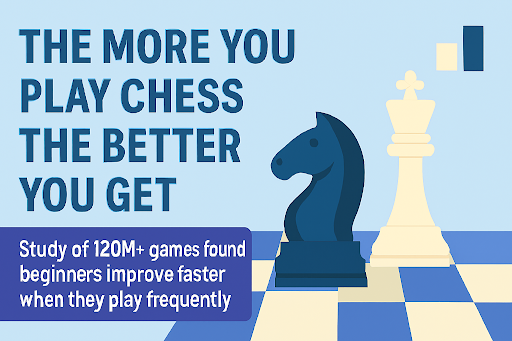
There’s one simple truth in chess: The more you play, the sharper you’ll become. It’s more than a motivational slogan as it has actual research behind it and is proven in the last several years from authentic sources and popular chess databases. The more than 120 million-game study revealed that newcomers who play regularly have longer “hot streaks” than professionals since repeating the moves helps them memorize opening and tactical moves quicker (Chowdhary, Iacopini, & Battiston, 2023).
Research on education is another level of study. Playing chess as a habit is associated with improved attention, planning, and problem-solving abilities of students (Blanch, 2022). Not entirely unexpected, this observation. In each game, you deal with various options, predicting threats, and thinking ahead is necessary. When you slow your pace, such skills develop slowly. Do it more, and they add up fast (Karakuş, 2023).
Which Time Control Helps You Grow Fastest
Not all games are created equally. In bullet chess with one to two minutes of thinking time for each player, it is incredibly fun but is primarily about training your reactions. Blitz chess with three to five minutes of thinking time allows you to notice some basic tactics but still allows you to have several games in one setting. Rapid games with ten to thirty minutes are best. This provides you with ample time to think thoroughly but still allows you to accumulate experience quickly. Classical games with thirty minutes of thinking time or more increase your calculation complexity and your patience but are slower to provide feedback (Narayan, 2025).
Coaches also recommend that Rapid is the means of improvement. A splash of Blitz for speed, and classy games for depth. Bullet is dessert. Fun and exciting but doesn’t have enough learning opportunities.
Reviewing Your Own Games
Playing is the fuel, but analyzing your games is the engine. After every game, it takes a few minutes to pause and reflect on these questions: Where did it all go wrong? Was it because of an unfamiliar tactical possibility? Or perhaps it was because you did not notice your opponent’s bishop sitting far away to devilishly crash your plan.
Chess engines have so much power, but being too dependent on them will make you a passive learner. If you’re new, adding your mistakes with tags such as “I missed a fork” or “Missed a quicker checkmate pattern” helps you develop your own bank of mistakes. This will enable you to identify the patterns in your mistakes and this is where the learning process accelerates.
Below is how you can do it:
| Game # | Opponent Rating | My Mistake | Missed Theme | Lesson Learned |
|---|---|---|---|---|
| 1 | 1250 | Dropped a rook | Did not see defender | Always check attackers before moving |
| 2 | 1320 | Missed mate in 2 | Back rank weakness | Watch King Safety in endgames |
| 3 | 1400 | Played wrong opening line | Forgot prep | Review opening notes before session |
How Many Games Should You Play
Here is one place where bullets are helpful:
- Beginners (U1200): Rapid-play games at the rate of 10-20 per week and short review sessions
- Intermediate (1200 to 1800): 5 to 10 quick games, 10 to 20 blitz games, and one classical game every week
- Advanced (1800+): 3-5 classical games with extensive analysis and blitz games for maintenance purposes
More games without review would mean slow growth. Less game with effective review means steady growth. More games with effective review mean faster growth.
Final Thought
Consistency is rewarded in chess. Play as often as possible and analyze in an intelligent manner while varying the time control. Rapid Chess openings shall be the most helpful part of your Chess education, while Blitz will keep your Chess skills honed and Classics shall stretch your brains. Bullet is for fun only – an espresso boost when you’re in a pinch.
So, the next time you’re on the fence about playing another game, just remember this: each game you play is another addition to the base of your chess knowledge. And just because you made a blunder may not be the end of the world… we’ve all been there each mistake you do if you analyze, will be considered as a progress.
Keep following The New England Chess School for important tips and lessons from our chess professionals.
References
Blanch, A. (2022). Chess instruction improves cognitive abilities and academic performance. Real effects or wishful thinking? Educational Psychology Review.
Chowdhary, S., Iacopini, I., & Battiston, F. (2023). Quantifying human performance in chess.
Karakuş, G. (2023). Chess and education. Educational Considerations.
Narayan, A. (2025). Which is chess’ most important format? Frequent switching raises questions.