
Chess has long been viewed as an intellectual pursuit. For centuries, people would depend on their own intellect in order to win. But in the past thirty years or so, chess has experienced a revolution through the development of artificial intelligence. From the shocking defeat of chess world champion Garry Kasparov by a computer in 1997 to the groundbreaking achievement by AlphaZero in 2017 and currently Leela Chess Zero and MuZero, AI technology has not just changed the way chess is being played but it has affected how we learn the game. This influence is especially evident in 2026.
Creativity in Playing Style
The previous generation of chess engines such as Stockfish utilized the technique of calculation, where millions of moves per second would be examined to find the best possible move to play. AlphaZero was completely different from its predecessors because of the utilization of machine learning to teach chess to itself by playing millions of games against itself. It managed to win against Stockfish within nine hours after the beginning of the experiment.
Even more surprising was not the victory of the artificial intelligence itself, but its style of playing which was characterized by sacrifices, positional strategy and aggressive attacking chess which was considered rather human-like. Garry Kasparov mentioned that “AlphaZero played with the spirit of a child”, whereas Magnus Carlsen stated that AlphaZero’s sacrifices are refreshing.
Lessons AI Taught Us
| AI Lesson | Human Response | Illustration |
|---|---|---|
| Sacrifice to gain initiative | Student prioritizes action over possession | AlphaZero versus Stockfish (2017) |
| Future planning | Tutors teach planning ahead | Leela’s long chain of moves in positional games |
| Learning through self-play | Schools promote learning by experimentation | Reinforcement learning is mistake-based |
| Risk acceptance | Chess players adopt risky strategies | Risks are rewarded by AI engines |
Such experiences teach us that chess is not all about learning openings. It involves creative thinking, being flexible to changes, and thinking big.
New Training Techniques in Modern Times
Modern chess training centers worldwide incorporate puzzles generated by AI to inspire creativity among players. Experts analyze games played by AI algorithms to update their own repertoires, while trainees are advised to try unusual moves.
For instance, AlphaZero versus Stockfish game is now considered as an illustration that sometimes sacrificing a piece on the board might be more beneficial than maintaining material.
Students are also advised to play chess against themselves to evaluate their strengths and weaknesses through introspective analysis. Such practice resembles the reinforcement learning engine training process.
Application in Real Life (2016–2026)
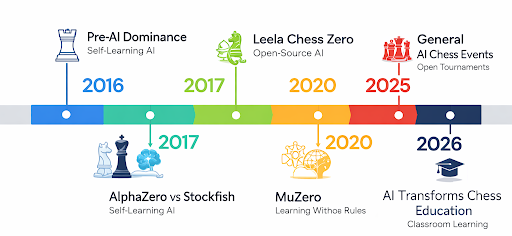
- 2016 — Conventional Engines: Stockfish and Komodo excel through raw computational power.
- 2017 — AlphaZero Revolution: Self-teaching computer defeats Stockfish, exhibiting innovation and risky moves.
- 2018 — Leela Chess Zero: Open-source project gains from transformers to influence opening and endgame strategies.
- 2020 — MuZero: Trains on chess without rulebook, paving way for innovative pedagogy.
- 2025 — AI Tournaments: Generalist AI engines participate in tournaments, gaining worldwide attention and increasing enrolment at schools.
Grandmaster Remarks
- AlphaZero by Kasparov: “It reminded me about the beauty in chess that had been forgotten by old computers.”
- Carlsen about AlphaZero: “The way AlphaZero makes its sacrifices is amazing; they keep reminding you to be creative.”
- Jan Gustafsson about AlphaZero: “Learning from AlphaZero is like learning from a grandmaster that never sleeps.”
- Leela Chess Zero by Peter Heine Nielsen: “Leela’s games were beautiful works of art, and they gave us a whole new perspective on openings and endings.”
- MuZero by chess teachers: “MuZero demonstrated to us that ruleless learning could inspire new approaches to teaching our students.”
- Tournaments for AI models (2025): “The participation of AI models in real events increased interest among young people.”
AI Limitations
- AI may lead to complications due to time pressure and psychological factors related to humans’ playing.
- High-level AI technologies require computational capacity. Therefore, educational establishments usually use pre-made game collections.
- The most effective way would be to combine AI courses with coaching, tournaments, and reflection.
Conclusion
This technology didn’t take away the creativity of humans but rather increased it. The use of such AI techniques as self-play, risk-taking approach, and forward thinking in schools can turn chess into a modern classroom where kids will learn critical thinking and be creative.
By 2026, it becomes clear that chess is not only about openings memorizations and book moves, it’s about preparing our children to face challenges and be creative. Keep following The New England Chess School for more informative blogs.