
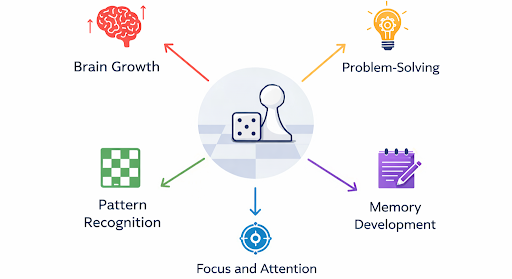
In an age that depends on constant innovation, the importance of cognitive skills cannot be overstressed. The pursuit of activities that aid intellectual growth without losing their appeal to kids is common among parents and educators alike. Out of many possibilities, there is one game that always delivers the goods and that is Chess.
This game is not about entertainment. It serves as a systemized method of building skills for your brain.
Critical Thinking and Problem-Solving
The game involves thinking ahead of time about possible moves and making decisions under pressure. It promotes good analytical skills and critical thinking. According to parents’ views from a survey conducted in Romania, chess contributes to the development of children’s intellect, personality, and emotional stability.
“Parents considered that chess helped their children develop positive emotions and helped them overcome negative emotions.”
This statement illustrates that chess is both a mental and an emotional game.
Case Study: Chess and Mathematics in Iran
The study done by Kazemi et al. (2012) was a laboratory experiment using Iranian primary and secondary school students. Students taught how to play chess performed better in solving mathematics problems than those who were not exposed to chess training. It is noted that chess improves analytical and forward-thinking abilities.
This example illustrates the relationship between chess and learning.
Good Case vs. Bad Case
| Scenario | Effect | Concluding Thoughts |
|---|---|---|
| Positive Scenario – Chess within the school curriculum | Children will exhibit better results in mathematics, increased concentration, and emotional control. | Chess becomes the agent that enables growth and success. |
| Negative Scenario – No chess within schools | Children will not be able to develop qualities such as foresight, patience, and resilience. | Children miss out on developing important skills. |
Fostering Creativity and Emotional Intelligence
Chess is ever-changing, and each move alters the board, forcing the child to be adaptable in his/her tactics. This fosters mental flexibility and creativity. The child learns how to solve problems from different perspectives, developing the ability to think creatively both in studies and daily life. Playing chess helps children handle their emotions well. Winning makes them feel confident, losing makes them persevere, and a tie makes them learn to be balanced. According to Aciego et al. (2012), chess promotes coping abilities.
Lifelong Cognitive Health
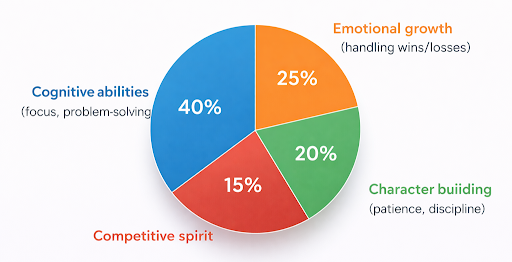
However, chess is not just an activity for kids; on the contrary, it becomes a habit that lasts throughout one’s life as long as the player gets hooked on the strategy and is thrilled at winning with “Checkmate.” What drives people to spend decades practicing chess is its boundless complexity that keeps everyone challenged.
Since no games can be the same as any other, all opponents provide something novel to solve and explore. Moreover, as one progresses, he learns more about openings, psychology of the game, and planning that develops his intellect and contributes to his overall mental abilities, as well as fosters.
| Stage | Skill Developed | Real-Life Impact |
|---|---|---|
| Childhood | Focus, patience, and discipline | Improved academic performance |
| Adolescence | Strategic thinking and foresight | Better decision-making and time management |
| Adulthood | Creativity and adaptability | Enhanced problem-solving in professional life |
Conclusion
Chess is more than just a game; it is a powerful stimulant of mental development, emotional strength, and innovation. Chess should be taught within the curriculum and at home by parents as a means of discovering and utilizing the inner potential of young minds preparing to face the future.
It has been proved that chess develops great thinkers, innovators, and leaders. It is high time we made use of the chess effect. Join The New England Chess School to start your chess journey.