
Many parents are concerned about what activities can help their child stand out for university admissions. Among the few activities that help students improve their academic performance, discipline, leadership skills, and a special personal story is chess. Universities want to admit students who can think critically, solve problems, and commit to long-term goals. These are all qualities that are naturally fostered through the game of chess.
In this blog, we will discuss how chess helps improve university applications, backed by research and a true story about a young chess prodigy who got into MIT.
Why Universities Value Chess
Universities are looking for more than just high grades. They are looking for students who are curious, who are able to withstand adversity, and who are able to think outside the box. Chess is an example of this.
According to a report produced by the University of Texas at Dallas (UTD), which has one of the best collegiate chess programs in the world, “chess players tend to be high achievers in school because it helps them develop strong analytical skills, discipline, and concentration” (University of Texas at Dallas, 2020). These are exactly the qualities that universities are looking for in students.
Skills chess develops that universities appreciate
- Critical thinking
- Strategic planning
- Pattern recognition
- Long-term focus
- Academic consistency
These skills can help students overcome the challenges of a competitive university program.
Admissions officers look for students who have made long-term commitments to an activity. Chess is an excellent choice, as progress can be measured by ratings, national standings, club positions, and coaching younger players.
A 2022 article from The Guardian pointed out the following about universities’ requirements for students, “University admissions officers are looking for evidence of ‘sustained commitment’ rather than short-term successes, and chess is the ultimate long-term commitment (Adams, 2022).”
Chess Strengthens Academic Skills
There is a strong link between chess and better performance in math, science, and computer science. Research published by the Education Endowment Foundation (EEF) in 2021 discovered that students in primary schools who were taught chess demonstrated better problem-solving and reasoning skills, which contribute to academic achievement (Education Endowment Foundation, 2021).
Academic skills strengthened by chess
| Skill | How Chess Helps |
|---|---|
| Problem-solving | Students learn to break down complex positions into steps |
| Memory | Players must remember patterns, openings, and strategies |
| Focus | Chess requires long periods of concentration |
| Analytical thinking | Students evaluate multiple possibilities before choosing a move |
These skills translate directly into better performance in school and standardized tests.
The Chess Prodigy Who Entered MIT (Andrew Tang, 2021)
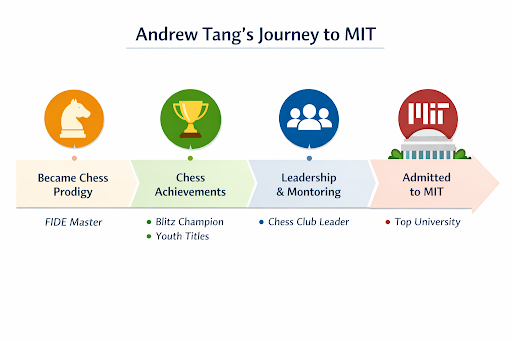
Andrew Tang, who is commonly known online as “penguingm1,” is one of the most renowned young chess prodigies of his generation. His story is an inspiring one that demonstrates how chess skills may be used to gain admission to an elite university such as MIT.
Andrew Tang is a FIDE Master who has gone on to become an International Master. He is best known for his outstanding skills at speed chess, especially bullet chess, at the highest level online. He is known to be creative and has an outstanding understanding of complex situations. Tang is not only renowned at the highest level of chess but also at an academic level.
Andrew Tang is not only known for his skills at chess but also for his outstanding leadership skills at an online level. He is known to have streamed educational content and has been instrumental in growing youth chess. MIT recognized Tang’s dedication to chess over a long period of time and his ability to be analytical and lead others. Tang’s achievements gave him a unique edge when he applied to MIT. He showed that he had strategic thinking skills and was able to be disciplined over a long period of time.
Why Parents Choose Chess for University Preparation
Parents often prefer chess for their children because it helps them build academic and personal strengths. Playing chess helps children learn to think ahead, use their time effectively, and stay calm under pressure. This is important for academic success in competitive universities.
Playing chess also helps students present themselves differently to college admissions officers. Many students may claim to have participated in activities such as sports or debating, but few can claim to have developed such depth of thought and discipline, especially in their growth over time, as can be achieved in chess.
References (APA Style)
Adams, T. (2022). Universities shift focus to long-term extracurricular commitment. The Guardian.
Education Endowment Foundation. (2021). Evaluation report: Chess in Schools and Communities.
Tang, A. (2021). MIT admissions profile and chess achievements. U.S. Education News Reports.
University of Texas at Dallas. (2020). Academic benefits of competitive chess participation.