
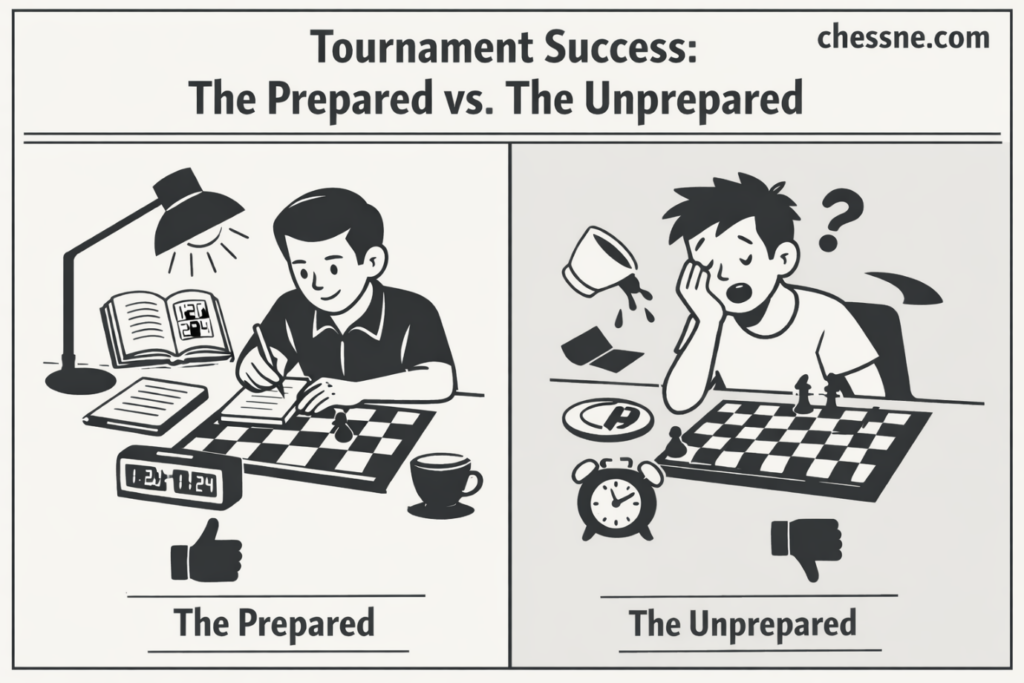
Competing in a chess tournament is a totally different from playing online or casual games. The pressure is higher. The games are longer. The margin for error is smaller. The distinction between a good tournament player and an average one is not necessarily based on ability. It is based on preparation, discipline, and composure.
Let’s analyse the key differences between successful players and those players who always performs bad in high stake tournaments.
Case Study: Prepared Player vs Unprepared Player
Imagine two 1600 rated players entering a 5 round classical tournament.
Player A: The Prepared Competitor
- Studies opening repertoire the week before the tournament
- Solves 20 tactical puzzles a day for 10 days
- Sleeps 7-8 hours before the competition
- Monitors time management during games
- Skims games briefly between rounds
Player B: The Casual Competitor
- Skims opening repertoire the night before the competition
- Fails to solve tactical puzzles
- Sleeps 5 hours before the first round
- Makes rushed moves in the opening
- Spends 90 minutes analyzing a game lost between rounds
After 5 rounds, typical outcomes look like this:
| Category | Player A | Player B |
|---|---|---|
| Opening mistakes | 1 to 2 minor errors | 3 to 5 serious inaccuracies |
| Average time left after move 20 | 45 to 60 minutes | 15 to 20 minutes |
| Blunders per tournament | 1 to 2 | 4 to 6 |
| Final score example | 3.5 out of 5 | 2 out of 5 |
The rating difference between disciplined and undisciplined tournament habits can easily equal 150 to 200 Elo points in performance.
Why Preparation Matters
Strong players think in terms of structure, not only the moves. For example, before playing the Sicilian defence, players study the pawn structure and the idea behind the opening, not the 20 moves involved in it. In fact, former World Chess Champion Magnus Carlsen repeatedly emphasizes the importance of understanding the position on the board more than memorizing the moves from a computer. This is also the reason he’s considered the king of freestyle chess nowadays.
Analysing the games from classical tournaments, it is found that the majority of blunders leading to a decision in a game happen after the 20th move, not in the first 10 moves. Therefore, understanding the middlegame is more important than the opening.
This is why daily tactical training is a necessity. In fact, studies on chess training programs show that solving 15-25 puzzles a day can improve calculation skills 4-6 weeks faster.
Time Management: A Hidden Rating Booster
Bad time management is a major enemy that can cause a player to lose a tournament.
Statistically, players who after 30 moves have less than 10 minutes on their clock in chess with a 90 plus 30-time control are more prone to make mistakes.
Strong players in the first 15 moves spend only 15 to 20 percent of their time keeping some extra time for important decisions in the middlegame. When the position gets sharp, they slow down Viswanathan Anand, the ex, World Champion, is famous for his time management skills. Even in very tense situations like the World Chess Championship, he used his time quite evenly and didn’t get panic.
One obvious fix is to keep an eye on your clock every 5 moves. A lot of players either rush their moves in winning positions or hesitate too much in equal ones. Being disciplined is the key to winning games.
Final Thoughts
Tournament success is not about brilliance. It is about habits. Preparation before the event, balanced time usage during the game, and emotional stability between rounds can easily add half to one full point in a five-round event.
At The New England Chess School, players have access to structured coaching, tournament practice, and guided analysis sessions. These tools help students build the same disciplined habits used by elite competitors.