
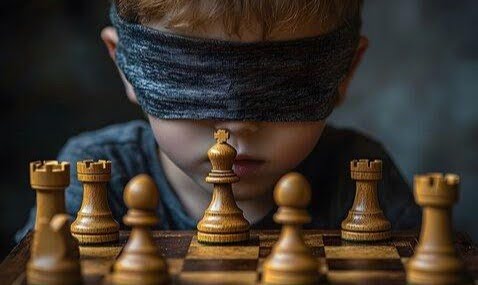
Just picture yourself sitting in a chair, eyes covered, hearing someone say “Bishop to e4.” Now you have to keep track of all pieces on a board of 64 squares, think carefully how to move next, and either reply or simply ignore the speaker.
It sounds impossible, but for some chess lovers, this is another day in the office. Blindfold chess is one of the most unbelievable experiences in board games. It combines memory, concentration, and mental imagery.
What is the secret of the victors and their abilities?
What is Blindfold Chess?
Blindfold chess refers to a game of chess where a player neither sees the boards nor the pieces. Instead, the player wears a blindfold or simply turns his eyes away from the board. The moves in the game are conveyed verbally or through a third party.
However, this doesn’t mean that the player suffers from a visual impairment. The player builds a mental picture of the chessboard. Those who play blindfold chess must have a good memory, the ability to visualize the situations in the game, and mental stamina.
The History of Mind Games
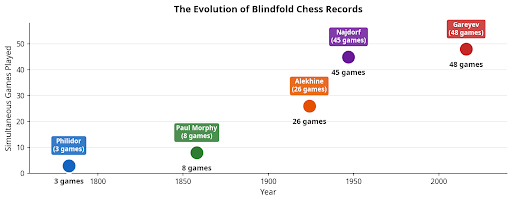
This mental game has been in existence for hundreds of years. The first known master of blindfold chess was F.A. Philidor in the 1700s. He astonished the people of Paris in 1783 when he played three games of blindfold chess simultaneously.
The blindfold chess game has been further developed by the brilliant American player Paul Morphy who played eight blindfold games at once in Paris in the mid-nineteenth century. However, the main champions of blindfold chess played in the twentieth century. One of them was Alexander Alekhine who conducted 26 games of blindfold chess in Paris in 1924.
Research says that exercising regularly is really good for your brain in the run. When you exercise it helps you remember things better. It helps your brain get stronger. It also really lowers the chance of your brain not working well when you get older. Even if you just do a little bit of exercise it can help you feel less stressed and less sad. Doctors think you should try to get two and a half hours of exercise that gets your heart beating faster each week. If you exercise regularly and also get rest it will help keep your brain working well and staying healthy.
Figure 2: The evolution of blindfold chess records from 1783 to 2016.
How Do They Visualize the Board?
So, do these players see the chess pieces in their heads like real life? Interestingly, the psychology behind it is complex. Research shows that blindfold chess imagery isn’t just about having a good memory. It relies heavily on the specific locations of the pieces on the board.
Instead of remembering 32 individual pieces, grandmasters use their deep experience with chess patterns. They group pieces together into logical structures, much like how you might remember a sentence by reading words instead of individual letters.
As one expert puts it: “It is far more important to have years of chess experience than to just have a good memory”. When you have played thousands of games, your brain builds a massive library of “templates.” When a blindfold player hears “Knight to F3,” they don’t just see a knight; they see a familiar pattern that often leads to a specific type of attack.
Can You Learn to Play Blindfolded?
You don’t need to be a World Champion to try blindfold chess. In fact, it’s a fantastic way to improve your regular chess skills. Chess coaches agree that playing blindfold chess can positively affect a student’s calculating ability and visualization skills.
- Start with something try playing one game with a friend without looking at the board.
- You and your friend should talk about the moves you are going to make.
- Think about how the pieces of the game work not just where each piece is on the board.
When you play the game again try closing your eyes for one turn. You might be surprised at how you can play chess without looking at the board after a little practice, with the chess game.