
Let’s talk about chess openings. Most people start the game by pushing a center pawn (like e4 or d4). It’s safe, it’s smart, and it controls the middle of the board. But what if you don’t want to play it safe? What if you want to play chess with a little bit of punk rock attitude?
Enter the Grob Opening
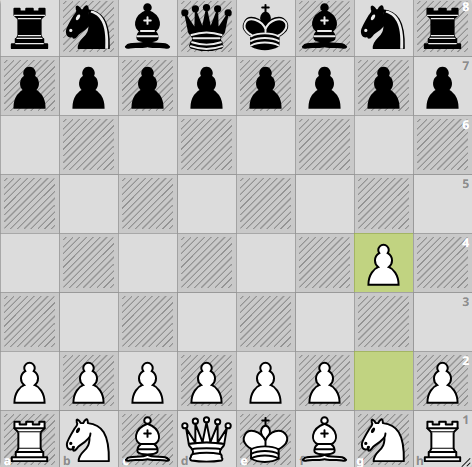
The Grob Opening begins with 1. g4. Indeed, you have read correctly. The white pawn on the square in front of the king’s bishop moves forward two squares.
A grandmaster would always frown upon the Grob Opening. They might describe it as “objectively bad” or “blunder.” The Grob Opening takes its name from the Swiss IM Henry Grob (1904-1971), who analyzed this opening extensively and played hundreds of correspondence games with it. However, when it comes to us non-grandmasters playing chess online, the Grob Opening is a tool of mass confusion.
Why Play 1. g4?
The concept of the Grob Opening is quite straightforward. It is all about catching your opponent off guard. Once you play 1.g4, Black has not been expecting that. There are no books, no lectures from the grandmasters, and surely no 2000 ELO players who employ such opening moves.
If Black plays adequately and White makes just minor mistakes in his game, it will be easy for Black to have a fairly substantial or even a decisive advantage. With the White move, the king’s side of the pawn structure gets seriously weakened, with the g-pawn occupying an unusual position that is hard to defend without the initiative being transferred to Black.
The Spike Attack
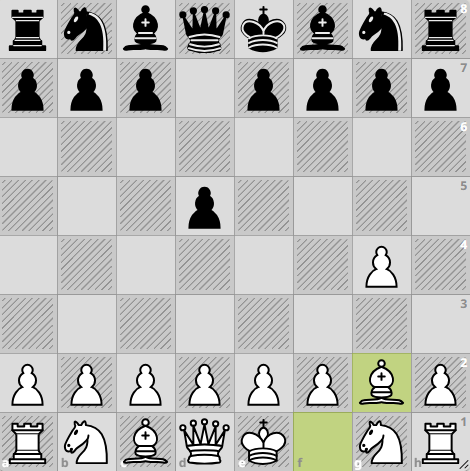
Another reason people play it is the “Spike Attack.” By playing 1. g4 followed by Bg2, you put a bishop on g2 that shoots a laser beam right at the queenside. It controls the long diagonal and can really mess up Black’s setup if they aren’t careful.
The Psychological Warfare
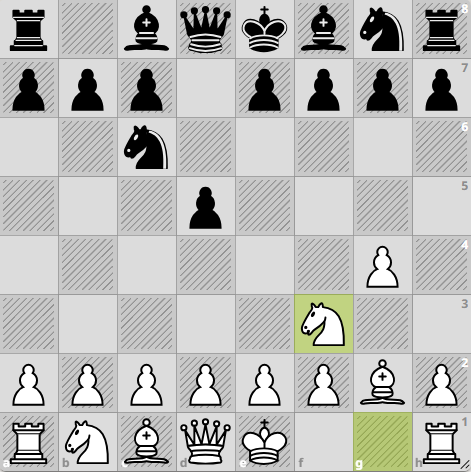
The most exciting aspect of playing the Grob is the psychology involved in it. Your opponent would probably be wondering whether you are a novice who has made some mistake, or whether you are a seasoned player when you begin with 1. g4. But after you follow up with Bg2 and Nf3, they understand that you’re a seasoned chess player.
From here onwards, your opponent may get confused or over-think or panic and make mistakes and blunders which will give you an edge over him from the beginning itself.
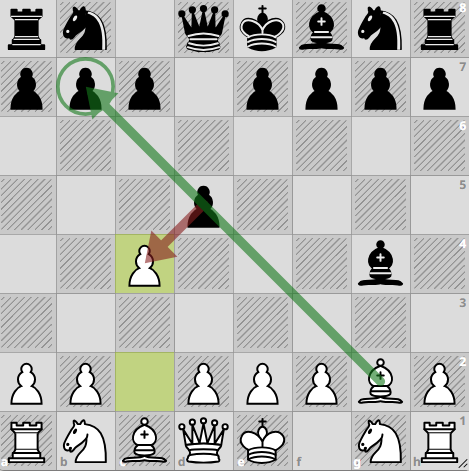
Just like in above example, offering c4 pawn for free? No because there’s bishop’s discovered attack that guarantee the rook capture.
You’ll see this especially in rapid or blitz games. People who are used to the London System or the Ruy Lopez will suddenly look at the board and not know what to do. They might waste precious seconds on the clock trying to figure out if you’re setting a trap. By the time they decide on a move, they’ve already lost the initiative.
After the most common 1…d5, 2. h3, e3, g5, and c4 are notable continuations.
The Dangers (Don’t Get Too Cocky)
Of course, playing 1. g4 has risks. If an unprepared player with Black tries to fixate on attempting to win the g4-pawn early, they can be led into dangerous territory. But if Black plays solid, you have to be careful.
It is important to develop your pieces quickly. If you play g4 and then just sit there playing a2, a3, and h3, you are just giving Black a huge advantage. You need to follow up with a solid plan, like playing d3 and e4 to grab some of the center back.
Grob’s Attack can often lead to ‘meme’ openings, such as a series of increasingly bold gambits named after fizzy drinks following on from the Double Grob 1…g5.
So next time you sit down for a blitz game, try the Grob. It might not be the best move according to the computers, but it’s definitely the most fun way to start an opening. Keep following The New England Chess School for more fun articles.