
Many parents wish to install confidence in their children when it comes to math, and many methods of doing this create anxiety in kids. Chess, however, is a fun and organic way to develop math skills. Studies done in recent years indicate that playing chess actually enhances skills that children use when it comes to math, such as logic, pattern recognition, memory, and problem-solving.
Read this blog to find out how playing chess helps children develop math confidence, backed by hard evidence and a real-life case study.
How Chess Builds Pattern Recognition
Mathematics is all about patterns, and children are exposed to many patterns in math, such as number patterns, shape patterns, patterns of symmetry, and patterns in algebra. Chess is also a pattern-based game, and children are exposed to many patterns in chess, such as patterns in tactics, patterns in openings, and patterns in checkmates.
According to a 2021 analysis done by Kids Academy, playing chess helps children develop cognitive skills such as pattern recognition, which is helpful when it comes to math (Kids Academy, 2021).
How Chess Strengthens Logical Thinking
Math follows step-by-step procedures. Chess helps children learn this. Each step in chess demands consequence analysis, comparing, and planning. This is exactly what children do while solving step-by-step math problems.
According to an article published by Rajawat in 2026, “Playing chess helps improve logical reasoning, step-by-step thinking, and decision-making skills, all of which are critical for math.”
While children have fun playing chess, they build their confidence to use these skills while solving math problems.
How Chess Improves Memory and Calculation
In the game of chess, players are always thinking about different possibilities: “If I do this, what is the next consequence?” This is similar to the process of mental mathematics, whereby children are required to retain numbers in their minds and think through different steps.
According to Patel’s research paper published in 2024, chess enhances mental aptitude, concentration, and thinking strategies, all of which are beneficial for mathematical performance (Patel, 2024). Children who are used to playing chess tend to improve their working memory, hence enhancing their concentration during mathematical problems.
How Chess Reduces Math Anxiety
Math anxiety is a significant block for many children. Playing chess helps overcome it because it helps children learn to stay calm and think clearly, even in tense situations.
In many studies, teachers reported that children who played chess became more confident about tackling challenging problems. This confidence is often directly applicable to math.
Real Case Study: Italian School Chess-Math Program (2021–2023)
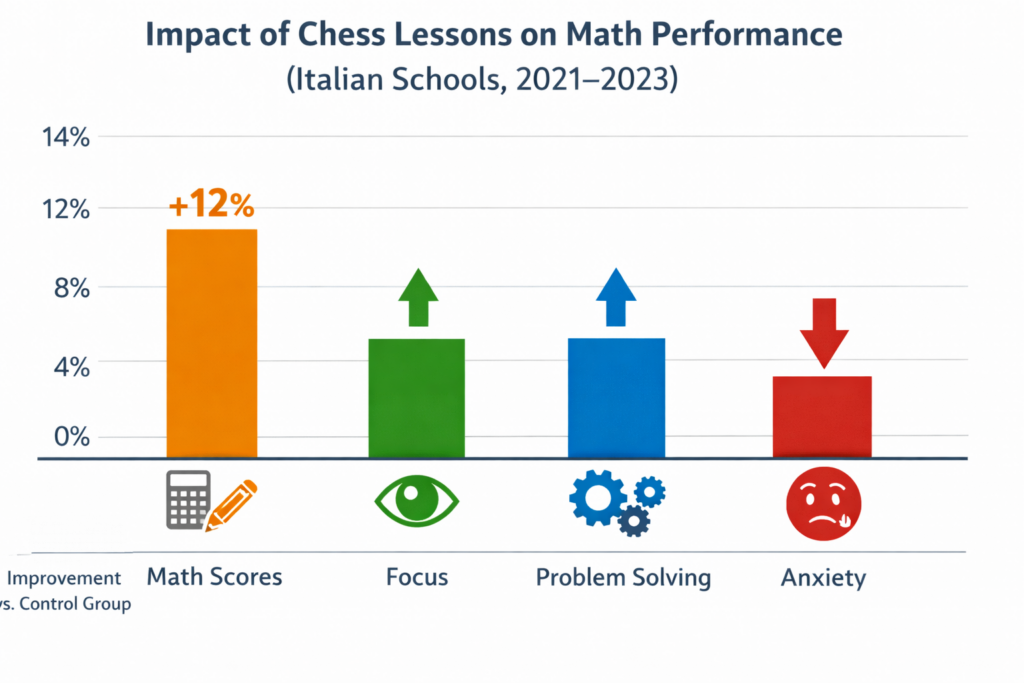
Several Italian primary schools ran a controlled experiment to measure the impact of chess on math performance. One group of students continued with regular math lessons, while another group replaced one math class per week with a structured chess lesson.
Key Findings from the Study
| Outcome Measured | Result |
|---|---|
| Math test scores | Up to 12 percent higher in the chess group |
| Student focus | Teachers reported better concentration |
| Problem-solving | Students showed stronger multi-step reasoning |
| Anxiety levels | Lower anxiety during math tasks |
This case study is widely referenced in educational discussions about the benefits of chess for cognitive development and math learning.
Why Parents Love Chess for Math Confidence
Parents like chess because it is a learning activity that is not work. It is also screen-free, social, and fun. Children develop skills to think ahead, to be patient, and to think creatively. Such skills help children to tackle math in a confident way rather than a fearful way.
Chess also teaches children to persevere. Children learn that mistakes are a normal part of playing chess. Such a lesson helps children to remain calm when they are making mistakes in math.
For many parents, chess is a simple and enjoyable way to help children develop and grow academically.
References (APA Style)
Kids Academy. (2021). The impact of learning chess on math skills. KidsAcademy.mobi.
Patel, A. (2024). Chess – Foundation for mathematics: In what ways can chess improve a child’s mathematical skills? Research Scholars Program, Harvard Student Agencies.
Rajawat, C. (2026). How chess can help US kids improve their math skills.
Italian School Chess-Math Program. (2023). Summary of findings on chess and math performance in primary schools.